Thursday, 18 November 2010

New Media Equipment at FCH LC

FCH LC now has some new items of media equipment available for loan.


For more details follow the links to the University of Gloucestershire Library catalogue (OPAC).


Camcorder :Creative Vado Pocket Video Cam X 2

Camcorder :Sony DCR DVD202E X 1

Camera :Fuji FinePix AX280 X 2

Camera :Fuji FinePix Z10fd x 1

Tripod :Sony Remote Control Tripod VCT-D680RM X 1

Voice Recorder :Olympus WS-450S X 3

See also the full list of FCH LC Media Equipment


If you would like to use any of the items of equipment available here please contact FCH LC Enquiry Desk on 01242 (71)4666, email lcinfofch@glos.ac.uk or call Rich Deakin on 01242 (71)4665, or email rdeakin@glos.ac.uk

Transferring your Mini-DV cassette footage

If you need to edit or transfer video footage for any of your assignments we can help you.

The FCH LC Edit Suite can be booked by contacting the FCH LC Issue or Enquiry Desks 01242 714666 or 714600, or by contacting Rich Deakin on 01242 714665, email rdeakin@glos.ac.uk


If you just need to transfer your video footage from mini-DV cassette onto a digital format such as DVD or USB flash drive without editing it first you can leave it with us and we'll do it for you.


More information about the Edit Suites

Wednesday, 17 November 2010

Off-air recordings for week 20-26 November 2010

Please email Rich Deakin rdeakin@glos.ac.uk ,or fchmediaservices@glos.ac.uk if you would like any of the following programmes / series recording.*

Sunday 21st

BBC2 - JFK: The Making of Modern Politics
- "On both sides of the Atlantic, John F Kennedy continues to be invoked by today's politicians in the hope that some of his magic might rub off on them. But, 50 years since Kennedy's election, Andrew Marr asks whether JFK's legacy has tarnished politics ever since.

Andrew examines in detail exactly what Kennedy stood for, and how the candidate got that message across. He goes in search of the substance that has long been obscured by the fascination with the Kennedy style.

He also examines how Kennedy embodied the hopes of a nation, and asks whether modern politics demands inspirational leaders rather than politicians bogged down in the details. Kennedy's soaring rhetoric set a high standard that people today yearn for politicians to reach."

Monday 22nd

BBC1 - Panorama: British Schools, Islamic Rules
- "Investigation which uncovers disturbing evidence that some children are being exposed to extremist preachers, fundamentalist Islamic groups and lessons with hate on the curriculum in Britain's Muslim schools. The programme asks why school inspectors have missed the warning signs and examines the impact this could have on young Muslims' ability to integrate into mainstream British life."

Tuesday 23rd

BBC2 - American Dream
- 3-part series - ""The American dream" - a phrase coined in 1931 that has become a national motto. It represents a unique brand of optimism that goes to the heart of what it is to be American. It is a simple phrase but a complex notion whose meaning is sustained and challenged by each generation.

After World War Two ended, Americans faced a future that seemed not only full of promise but also replete with danger. The United States emerged as the richest and most powerful nation in the world yet its safety and even its existence were widely perceived to be threatened as never before.

This series features those who helped foster and sell the dream, those who feel they have lived it, as well as those who challenge or reject the very notion. Through rare archive and eyewitness testimony, this series explores the realities behind America's most powerful myth - from the eve of the Second World War to the end of the Vietnam War."

BBC4 - Delphi: The Belly Button of the Ancient World - "What really went on at the ancient Greek oracle at Delphi, how did it get its awesome reputation and why is it still influential today?

Michael Scott of Cambridge University uncovers the secrets of the most famous oracle in the ancient world. A vital force in ancient history for a thousand years it is now one of Greece's most beautiful tourist sites, but in its time it has been a gateway into the supernatural, a cockpit of political conflict, and a beacon for internationalism. And at its heart was the famous inscription which still inspires visitors today - 'Know Thyself'."

Wednesday 24th

BBC4 - Time To Remember: Civilians At War
- "The impact of two world wars on the UK's civilian population is told through newsreel footage and voiceover from the original 1950s series Time to Remember. Here are the war stories from the home front.

Includes footage of circus elephants being used as farm animals during the Great War; a pram protected against gas attack; footage of Londoners bedding down in the Underground during World War Two; and the celebrations at the end of both global conflicts."

BBC4 - Storyville - Mandelson: The Real PM? - "Documentary following Peter Mandelson in the run-up to the 2010 general election. Hannah Rothschild's film shows Mandelson at his ministry, masterminding the election campaign and dealing with colleagues such as Gordon Brown and Alastair Campbell. With unprecedented access to key events and conversations, this is a fascinating behind-the-scenes exploration of British politics."

More 4 - Not Forgotten: Survival - "Although promised a 'land fit for heroes', many returned to poverty and unemployment. Ian Hislop remembers the five million men who fought in the First Word War but survived."

Friday 26th

Channel 4 - Dispatches: City of Fear
- "For one year, Dispatches follows the police and people of Islamabad as Pakistan's capital battles to overcome an unprecedented wave of terrorist attacks, providing a powerful insight into a normally closed world in which everyone battles to survive the daily threat of death with courage and resilience.
Pakistan is in chaos; more than 3,500 people have been killed in suicide blasts in the past three years. Only a few years ago, attacks in the capital were rare, but disparate terrorist groups are increasingly working together and Islamabad has become their ultimate target.
Featuring intimate, direct-to-camera interviews of startling candour - from a teenage girl whose best friend was blown up, to the Inspector General of Police - Dispatches follows those affected as they attempt to continue their lives on the frontline of a war on terror - and refuse to be beaten by it.
With unprecedented access, including interviews filmed in the immediate aftermath of explosions and behind-the-scenes footage of police investigations, the film documents the real war on terrorism fought on the streets of the metropolis... with bloody and tragic consequences."

Channel 4 - Unreported World - Senegal: School For Beggars - "Unreported World investigates Senegal's Islamic schools.
Reporter Seyi Rhodes and director Simon Philips reveal how many young boys living in the religious schools are subjected to abuse, and forced by their guardians to beg on the streets for their survival. And they meet those trying to save the children from exploitation and abuse.
Senegal is a modern, relatively wealthy African country yet the team meet huge numbers of boys in the capital, Dakar, who tell them they have to beg for their education.
Yaro, like around 50,000 other children, is one of the 'Talibes': religious students whose parents have sent them to boarding school to learn the Koran. He tells Rhodes how he's only been home once in four years and has spent that time begging with his classmates from a religious school, known as a daara.
Rhodes and Philips meet other boys who are in a similar position; many have quotas to fill for the day. They claim that if they do not return with the desired amount of money or food they will be beaten by the religious guardians, known as Marabouts.
The team also meets Kahn, a community worker in a poor suburb of Dakar. He leads them through the back streets to a rundown house that turns out to be a school. The teacher tells Rhodes he is going to sell everything his boys have collected and hopes to make the equivalent of five pounds from doing so.
Rhodes discovers how brutal some punishments can be for boys who don't make their targets. He meets two young boys who were so severely beaten they are scarred for life. They break down and tell him they would be tied up if they hadn't managed to bring back the correct amount required by their guardians. Their teacher was one of the few who was prosecuted and the boys are now cared for in a government-run children's home.
Rhodes also talks to Professor Ndiaye, an Islamic scholar who blames the unquestioning trust Senegalese people have in their Marabouts. He explains that when children lived in the countryside villagers would support the daara by feeding its students, but as people moved into cities following successive droughts this rural system broke down.
The team visits another Koranic school, which is formal but well run and clean. The teacher explains to Rhodes the main problem with bad schools is poverty. Families are keen for their children to receive a Koranic education but few can pay and few marabouts can afford to offer decent facilities.
Rhodes and Philips also meet Babakar, a 16-year-old from Gambia. He was sent to Senegal to learn the Koran four years ago, but ran away when the begging and beating became too much. He's now sleeping rough, too afraid to return to his school and too poor to make his way home to his parents.
Rhodes concludes that not all the boys from Senegal's daaras will end up living on the streets like this, but while the system remains harsh and largely unreformed, many of them probably will."

BBC2 - Gardener's World Special: The Science of Gardening - "Carol Klein transforms her garden into a laboratory as she learns about the science behind gardening. In an effort to better understand how plants grow in different conditions, she enlists the help of experts to analyse soil, compost, seeds and weather so she can become a more efficient horticulturist."


----------------------------------------------------------------------------------------


* This applies to staff members and students at the University of Gloucestershire only. Any recordings made are to be used only for educational and non-commercial purposes under the terms of the ERA Licence.

Tuesday, 9 November 2010

Off-air recordings for week 13-19 November 2010

Please email Rich Deakin rdeakin@glos.ac.uk ,or fchmediaservices@glos.ac.uk if you would like any of the following programmes / series recording.*


Sunday 14th


BBC2 - Making Scotland's Landscapes - 5-part series - "Professor Iain Stewart presents a landmark five-part series in which he reveals how Scotland's unique and beautiful landscape has been shaped over the centuries.
In this first programme, he uncovers how, over thousands of years, the actions of mankind and the climate nearly led to the downfall of Scotland's trees and forests. It was only in the 18th century that man realised the extent of the damage to timber stocks, and measures were taken to re-populate the landscape. The impact was profound, but not everyone agreed with the results."


Monday 15th


BBC4 - Greek Myths: Tales of Travelling Heroes - "Eminent classical historian Robin Lane Fox embarks on a journey in search of the origins of the Greek myths. He firmly believes that these fantastical stories lie at the root of western culture, and yet little is known about where the myths of the Greek gods came from, and how they grew. Now, after 35 years of travelling, excavation and interpretation, he is confident he has uncovered answers.
From the ancient lost city of Hattusas in modern Turkey to the smouldering summit of the Sicilian volcano Mount Etna, the documentary takes the viewer on a dazzling voyage through the Mediterranean world of the 8th century BC, as we follow in the slipstream of an intrepid and mysterious group of merchants and adventurers from the Greek island of Euboea. Its in the experiences of these now forgotten people that Lane Fox is able to pinpoint the stories and encounters, the journeys and the landscapes that provided the source material for key Greek myths.
And along the way, he brings to life these exuberant tales - of castration and baby eating, the birth of human sexual love, and the titanic battles with giants and monsters from which the gods of Greek myth were to emerge victorious."


BBC4 - Aristotle's Lagoon - "In the 4th century BC the Greek philosopher Aristotle travelled to Lesvos, an island in the Aegean teeming, then as now, with wildlife. His fascination with what he found there, and his painstaking study of it, led to the birth of a new science - biology. Professor Armand Leroi follows in Aristotle's footsteps to discover the creatures, places and ideas that inspired the philosopher in his pioneering work."


Tuesday 16th


BBC1 - Horizon: Deepwater Disaster: The Untold Story - "Horizon reveals the untold story of the 87-day battle to kill the Deepwater Horizon oil blowout a mile beneath the waves - a crisis that became America's worst environmental disaster.
Engineers and oil men at the heart of the operation talk for the first time about the colossal engineering challenges they faced and how they had to improvise under extreme pressure.
They tell of how they used household junk, discarded steel boxes and giant underwater cutting shears to stop the oil.
It's an operation that one insider likens to the rescue of Apollo 13."


Wednesday 17th


BBC4 - Time To Remember: Crime and Prohibition - "Newsreel footage and voiceover from the original 1950s Time to Remember documentary TV series tells the story of the media circus that surrounded notorious gangsters and other Depression-era criminals in the United States of America. This is encapsulated in the kidnapping of Charles and Anne Lindbergh's baby - the 'crime of the century'.
Includes footage of rumrunners trying to outrun the US Coastguard and beat prohibition; mobster Jack 'Legs' Diamond; John Dillinger behind bars; Al Capone at the racecourse; and coverage from inside the courtroom during the Lindbergh baby murder trial of German illegal immigrant Bruno Richard Hauptmann."


Thursday 18th


BBC4 - The Beauty of Diagrams - 6-part series - "Documentary examining diagrams, beginning with Leonard Da Vinci's masterwork Vitruvian Man. The piece, drawn in the 1480s, combines the artist's passions for anatomy and geometry, and also illustrates an ancient architectural riddle set out 1,500 years earlier by the classical writer Vitruvius - a puzzle that still fascinates experts to this day."


Friday 19th


Channel 4 - Unreported World: India - Love on the Run - "As more young couples reject arranged marriages in modern India, Unreported World investigates a wave of violence that's left hundreds dead across the country's northwest states.
Reporter Annie Kelly and director Katherine Churcher reveal that, despite Indian law giving everyone the right to marry who they want, increasing numbers of young couples are facing death at the hands of their own families for defying centuries of tradition.
Kelly and Churcher begin their journey in Delhi with the Love Commandos, an activist group trying to protect young couples from violence. The team travels with them to the central train station to meet Santosh and Guarav, a young couple on the run. They say they were forced to flee to the capital after Santosh was attacked by her family. They explain that they are from different Hindu castes, which makes their relationship forbidden in the eyes of her village.
An estimated 900 people have been killed in honour-related attacks in India in just a year, with the numbers continuing to rise. Kelly and Churcher follow the murder trail to Haryana, the northwest province where many attacks have taken place.
They visit the village of Nimiliwali, the scene of a brutal double murder just six weeks earlier. A local man says that two teenagers were beaten then hanged by the girl's family after they discovered their secret relationship. The chief of the village takes the team to the house where they were killed and says their deaths were inevitable because they broke tradition and acted without the consent of the family.
The team discovers that families are not always acting alone. They hear allegations that powerful extra-judiciary traditional councils of village elders called Khap Panchayats are also implicated in the murders and may have even ordered killings."


----------------------------------------------------------------------------------------


* This applies to staff members and students at the University of Gloucestershire only. Any recordings made are to be used only for educational and non-commercial purposes under the terms of the ERA Licence.

Tuesday, 2 November 2010

Off-air recordings for week 6-12 November 2010

Please email Rich Deakin rdeakin@glos.ac.uk ,or fchmediaservices@glos.ac.uk if you would like any of the following programmes / series recording.*

Saturday 6th

BBC2 - Timewatch: The Last Day of World War I
- "Broadcaster Michael Palin tells the story of how the First World War ended on 11th November 1918 and reveals the shocking truth that soldiers continued to be killed in battle for many hours after the Armistice had been signed. Recounting the events of the days and hours leading up to that last morning, Palin tells the personal stories of the last soldiers to die as the minutes and seconds ticked away to the 11 o'clock ceasefire."

Sunday 7th

BBC2 - Stephen Fry and the Great American Oil Spill
- "Stephen Fry loves Louisiana. Four months after the BP oil spill, dubbed the worst ecological disaster in the history of America, Fry returns to the Deep South together with zoologist Mark Carwardine, to see what the impact has been on the people, the vast wetlands and the species that live there. What they find both surprises and divides the travelling duo."

BBC1 - The First World War from Above - "The story of the Great War told from a unique new aerial perspective. Featuring two remarkable historical finds, including a piece of archive footage filmed from an airship in summer 1919, capturing the trenches and battlefields in a way that's rarely been seen before. And aerial photographs taken by First World War pilots - developed for the first time in over ninety years - show not only the devastation inflicted during the fighting, but also quirks and human stories visible only from above. Presented by Fergal Keane"

Monday 8th

Channel 4 - Dispatches
- "An investigation into the working conditions in clothing manufacturing units in the UK reveals poor treatment of workers making clothes which end up being sold by large fashion retailers."

BBC4 - Gods and Monsters: Homer's Odyssey - "Virginia Woolf said Homer's epic poem the Odyssey was 'alive to every tremor and gleam of existence'. Following the magical and strange adventures of warrior king Odysseus, inventor of the idea of the Trojan Horse, the poem can claim to be the greatest story ever told. Now British poet Simon Armitage goes on his own Greek adventure, following in the footsteps of one of his own personal heroes. Yet Simon ponders the question of whether he even likes the guy."

Tuesday 9th

BBC2 - Alan Titchmarsh's Garden Secrets
- 4-part series - "Alan Titchmarsh reveals the amazing secrets behind Britain's great gardens, examining how they continue to influence gardeners, including himself, today."

BBC4 - A Time To Remember: The Pursuit of Peace - "Material from the 1950s newsreel documentary series Time to Remember tells the story of the struggle to maintain peace in the decades after the Great War. The politicians' high hopes for improved international relations through the League of Nations were gradually eroded by expansionism and aggression across the globe.

Includes footage of the signing of the Treaty of Versailles; the first Armistice Day parade in 1919; Ramsay MacDonald addressing the League of Nations in 1924; Neville Chamberlain's visits to Germany to negotiate with Hitler; the liberations of Rome and Paris in the summer of 1944; the signing of the German surrender in 1945; and the signing of the United Nations charter."


Wednesday 10th

BBC2 - Edwardian Farm
- 12-part series - "Following the huge success of the Victorian Farm series, BBC Two is presenting the same intrepid team with a brand new set of challenges as they are forced to get to grips with the trials and tribulations of life on an Edwardian Farm.

Archaeologists Alex Langlands and Peter Ginn and domestic historian Ruth Goodman will return to front Edwardian Farm, spending a full year delving into Britain's rural heritage.

They will make their home in a stunning new location, exploring the challenges posed by the British countryside at a time of great change and tumult; a time when farming was becoming increasingly mechanised at home, and abroad the world was moving gradually towards war.

As in the first series, the action will be based primarily on the farm, but the new setting will also allow the team to explore wider aspects of the working countryside, including rivers and coasts, boat-building, mining, fishing and market gardening."

BBC2 - Ancient Worlds - 6-part series - "BBC Two's Ancient Worlds, is a six-part odyssey from the first cities of Mesopotamia to the Christianisation of the Roman Empire with archaeologist and historian Richard Miles at the helm. The series tells the story of what Richard argues is mankind's greatest achievement – civilisation.

The series offers an epic sweep of history against a panorama of stunning locations and bold propositions about the origins of human society.

In the 21st century we might fondly imagine that it is humankind's natural state to live together in communities that extend beyond blood ties. As Ancient Worlds sets out to show, however, no such assumptions were made by the first clan chiefs who decided to form communities in southern Iraq in 4500 BC. There is nothing natural about the city, and its founders understood that its very survival relied on compromise, ruthlessness, sacrifice and toil.

In the West we have consigned the term 'civilisation' to the museum display case. Embarrassed by its chauvinistic and elitist connotations, we have increasingly taken refuge in more politically correct and soft-focused terms such as 'culture' to explain our origins. This series seeks to rescue civilisation from its enforced retirement and celebrate such a hard-fought invention."

More 4 - Not Forgotten - "Ian Hislop examines how the experience of the war transformed Britain's rigid class system."

Thursday 11th

BBC4 - Battlefield Poet: Keith Douglas
- "Documentary exploring the life and work of Keith Douglas, one of Britain's finest poets of the Second World War. Whilst the poets of 1914-18 are generally widely published, those writing during the Second World War are largely forgotten. Poet Owen Sheers documents Douglas's extraordinary talents and combat experiences as a tank commander, from the epic battles of the Western Desert to his death in Normandy three days after D-Day."

Friday 12th

Channel 4 - Unreported World - Central African Republic: Witches On Trial
- "The Central African Republic is a country obsessed with black magic, where nearly half the prison population are convicted witches.
In villages and the capital witchcraft is used to explain every misfortune and it is such a powerful weapon that it is a feature of almost every family quarrel or village dispute. And, as Unreported World reveals, it's often the most vulnerable who are singled out.
Reporter Seyi Rhodes and director Julie Noon's journey begins at a ceremony performed by a traditional healer. She claims to have the power to expose black magic by looking into a fire and seeing the names and images of witches. During the ceremony she pulls a small boy from the crowd and announcing that he turns into a horse at night and eats people.
Healers like Marceline wield huge influence across the country and their authority is rarely questioned. She tells Rhodes her most recent case involved exposing a local man as a witch and that he was subsequently arrested and imprisoned.
Since independence from France in 1960 it's been illegal to use charlatanism and sorcery to harm others. Those found guilty can be jailed for up to ten years or even sentenced to death. Rhodes and Noon travel to Mbaiki prison. The Governor says he chains up all new suspected witches for the first seven days, but despite this one prisoner managed to escape; the governor claims he turned into a rat or snake and tunneled out.
Rhodes finds one prisoner, Francois, awaiting trial. He claims that although he was labeled a witch by his neighbours he is innocent. Francois says he was tied up, beaten by fellow villagers and dragged to the police station where he confessed.
Even though it is against the law there is no explanation in the penal code to what actually constitutes witchcraft. Rhodes speaks to the police to find out how they go about tackling a phenomenon that isn't even defined. A senior police captain says eyewitness testimony is enough for him to prosecute.
The team attends Francois's trial. His case, like others, seems to be based on rumour, hearsay and forced confessions. In court there's a big turnout. The judge begins by reading the charges and Francois's lawyer submits his plea of not guilty. A traditional healer is brought in and testifies he saw Francois turn into a dog and bite a man. Much to everyone's astonishment Francois pleads guilty. After the trial he tells Rhodes he was too scared to deny it.
Travelling north to Sibut, the team visits the local prison where more than half the prisoners are accused or convicted of witchcraft. The inmates protest their innocence and most of them seem to be a victim of quarrels with relatives or neighbours, which had all resulted in accusations of witchcraft being made. They all appear to be vulnerable, from the elderly to people who were living on their own.
Back in the capital, one of the country's most senior prosecuting judges - Arnaud Djoubaye - admits there is a problem with the law. He says there is no legal definition of the concept of witchcraft, which can be confusing and vague. However he's convinced witchcraft is a real and present threat to the population and believes the laws should remain to allow the judiciary to take action."


----------------------------------------------------------------------------------------

* This applies to staff members and students at the University of Gloucestershire only. Any recordings made are to be used only for educational and non-commercial purposes under the terms of the ERA Licence.

Wednesday, 27 October 2010

Off-air recordings for week 30 October - 5 November 2010

Please email Rich Deakin rdeakin@glos.ac.uk ,or fchmediaservices@glos.ac.uk if you would like any of the following programmes / series recording.*

Saturday 30th October

BBC2 - Timewatch: The Pharaoh's Lost City
- "It's 1350BC; Egyptian pharaoh Akhenaten - ruler of the biggest empire in the ancient world - commands his people to move 400 km and build a huge city from scratch to house his new religion.

The city of Amarna was the place of the most dramatic upheaval in the 3,000 year religious history of Ancient Egypt and the vision of just one man. Here Akhenaten would shrink the old world of 2,000 gods to 1. He would give his queen - the beautiful Nefertiti - equal status and he would radically change art and society. He set out to create the greatest city the world had ever seen and it appeared he had succeeded. But the pharaoh’s great city would last just 20 years.

For over a century archaeologists have been excavating the ruins at Amarna. But recently a team under the directorship of Prof. Barry Kemp (University of Cambridge) has made a remarkable discovery. For the first time they have unearthed, in a desert cemetery, the skeletons of Amarna’s workers; the people who built and lived in the city.

What these 3,500 year old human remains are revealing, is a city very different to what was previously thought. Far from being a place of plenty, biological anthropologist Prof. Jerry Rose (University of Arkansas) has discovered trauma on the vertebrae of youths in Akhenaten’s city, the evidence of backbreaking work. High rates of Anaemia –particularly in the bones of children - is evidence of a chronic diet.

With unique access to a 30-year long project, using dramatic reconstruction and Computer Generated Imaging, Timewatch reveals the hidden truths of life in Amarna, during one of the most turbulent periods of Egyptian history - the time of the rebel pharaoh..."


Channel 4 - Apocalypse: the Second World War - "This six-part series tells the epic story of World War II, providing an insight into the experiences of the millions of soldiers who fought across countries and continents, and the moving stories of the millions of civilians who saw their homes destroyed and lives disrupted by the cataclysm of war.
To tell this story, the best footage of World War II has been painstakingly transformed into colour, using digital techniques. Along with original colour home movies."

Monday 1st November

BBC2 - Tea Party America: This World
- "The fastest-growing political movement in the US today is the so-called Tea Party - a right-wing grassroots revolt with hundreds of thousands of supporters and local branches all over the country. Now as the US prepares to vote in crucial mid-term elections, political journalist Andrew Neil is off on a whistle-stop tour of the country to find out what is behind it and why it is spreading like wildfire. The Tea Party wants to change America - but their first target is the Republican Party.

Urged on by the likes of Fox News' most prominent host, Glenn Beck, and the Tea Party darling Sarah Palin, they are trying to replace established Republican politicians with Tea Party candidates. But as Andrew Neil discovers, their real target is the man in the White House. They believe Obama is an out-and-out socialist and the Federal Government well on the way to what they see as tyranny. This extraordinary eruption of anger is certainly changing the face of America."

Channel 4 - Dispatches: Street Kids - "Street Kids: Dispatches follows four teenagers over six months who are struggling to fend for themselves on the streets across Britain. They're simultaneously at risk and a risk to society."

Channel 4 - Coppers - 6 -part series - "Series Summary As police budgets, and numbers, come under threat, this hard-hitting series reveals what police officers across England really think about being on the frontline of 21st-century Britain.
With access to police forces across the country - from Kent to West Yorkshire and Greater Manchester to Cambridgeshire - and from inner cities to rural beats, Coppers shows what police officers are up against every day of their working lives.
The series captures the reality of the job: from the riot police who face serious public disorder on our streets, to the seasoned custody sergeants who've seen it all, from the staff facing time-wasters calling 999 to emergency response teams racing to the scene only to find themselves acting as social workers or marriage guidance counsellors, and from traffic cops picking up the pieces after accidents to the thin blue line who face abuse and violence from binge-drinkers every weekend."

Tuesday 2nd

BBC4 - Natural World: Cuckoo
- "The sound of the cuckoo is to many the very essence of spring, yet behind the magical call is a bird that is a cheat, a thief and a killer. Just how does the cuckoo trick other birds into accepting its eggs and raising its young? Why don't the duped foster parents react as they watch the baby cuckoo destroy their own eggs and chicks? And why do they work so relentlessly to feed a demanding chick that looks nothing like them and will soon dwarf them?

In this film, new photography is combined with archive footage and the latest scientific findings to solve a puzzle which, as narrator David Attenborough explains, has perplexed nature-watchers for thousands of years."

BBC4 - Twitchers: A Very British Obsession - "Every year, a secret tribe take to the roads of Britain. In the space of a few months they will drive thousands of miles and spend thousands of pounds in pursuit of their prey. Their aim is to see as many birds as possible, wherever that bird may be.

Welcome to the very competitive world of the twitcher - obsessives who'll stop at nothing to get their bird."

BBC2 - Turn Back Time: The High Street - 4-part series - "BBC One brings the story of the British High Street to life in Turn Back Time, an exciting and ambitious new series that transports four empty shops and a group of contemporary shop-keeping families back to the High Street's heyday in the 1870s, before propelling them through a century of dizzying change right up to the Seventies.

In the picturesque market square in Shepton Mallet, Somerset, the families' lives are turned upside down as they get to grips with how shopkeepers lived and worked in six key eras of British history.

Laced with real-life entertainment, family drama and human endeavour, the families have to deal with whatever history throws at them.

Alongside all the usual pressures of running a business, they'll have to learn traditional skills and make their own produce by hand – each episode throwing new challenges their way as the High Street marches on into the modern era.

They are overseen by Turn Back Time's own unique chamber of commerce (Gregg Wallace, Tom Herbert and Juliet Gardiner), which sets the challenges for each era and enforces accurate rules and regulations – revealing who has delivered on best customer service and weekly sales as the decades tick by.

The families will also live the life of each period, dressing, eating and playing as they once would have done – from 18-hour working days and wartime rationing, to evenings of entertainment sitting around the wireless, they'll experience it all.

But these are no museums. The shops will be serving modern-day customers who are used to the pace and convenience of 21st-century shopping.

While the shopkeepers struggle with pounds, shillings and pence, will their customers welcome the old-fashioned delights of personal service and hand-delivered goods or will queuing, weighing and hand-wrapping tax their patience?

BBC Learning is also offering viewers the chance to continue the Turn Back Time experience in their own area. Working with local history societies museums, libraries and archives, Hands On History will offer a range of events and activities around the country, including a number of historical pop-up shops."


BBC2 - Eat, Pray, Light - "What is Diwali? For many it's like Christmas and New Year rolled into one day in October-November. But few non-Hindus might know that Diwali is in fact the third day in a festival that lasts no less than five days.

This documentary features a cast of British Hindus, including a family, priests, theologians, artists, entrepreneurs, and The One Show's Anita Rani, who day by day reveal the meaning of each ritual and custom.

Colourful original illustrations of iconic stories from the Hindu scriptures show how each day is a celebration of a distinct spiritual and moral message designed to help every Hindu cast off their secular baggage and replenish their inner spiritual light."

BBC4 - A Time To Remember - Nations At Play - "Lesley Sharp narrates as original newsreel and 1950s voiceover are used to illustrate how Britons spent their leisure time during the first half of the 20th century. Includes footage of Henley regattas, frolics at the seaside, the Victorian fairground, horse riding in Hyde Park, Royal Ascot in 1919, Deauville in the 20s and the British Empire Exhibition at Wembley."

Wednesday 3rd

BBC2 - Natural World: The Dolphins of Shark Bay
- "A dolphin is about to be born in the treacherous waters of Shark Bay in Western Australia. Puck, the wise mother, must use all her skills to keep her newborn safe from the sharks that sweep into the bay every year. With the help of her close knit family of females she must teach the vulnerable baby dolphin the secrets of survival. From whistling to her unborn calf, to the first few hours of baby Samu's life and the struggles her eldest son faces leaving home, this film provides a rare insight into the lives of bottlenose dolphins."

BBC2 - Horizon: Asteroids - The Good, The Bad and The Ugly - "Famed for their ability to inflict Armageddon from outer space, asteroids are now revealing the secrets of how they are responsible for both life and death on our planet.

Armed with an array of powerful telescopes, scientists are finding up to 3000 new asteroids every night. And some are heading our way.

But astronomers have discovered that it's not the giant rocks that are the greatest danger - it's the small asteroids that pose a more immediate threat to Earth.

Researchers have explained the photon propulsion that propels these rocks across space, and have discovered that some asteroids are carrying a mysterious cargo of frost and ice across the solar system that could have helped start life on earth."

BBC4 - A History of the World: The Clock That Changed The World - "Adam Hart-Davis tells the story of the amazing 280-year-old wooden clock, made in Lincolnshire, that changed timekeeping for ever and helped solve the problem of how to navigate round the world.

Adam tells the amazing story of John Harrison and gets to grips with the clock in Leeds, helping to put it together and make it run. He also makes his own wooden clock to show how Harrison did it.

Adam takes to the sea at Hull to show why finding your position was so difficult in the 1700s and why sailors so often got it wrong, with tragic results. He shows how Harrison changed all that, eventually designing an incredibly accurate portable watch that Captain Cook took on his second voyage.

Bringing the story bang up to date, Adam shows how the idea of using time to find your position was key to Captain Cook, but is also at the heart of today's satellite navigation systems. On the way, he finds evidence of John Harrison and his brother James (also a joiner) round north Lincolnshire."

BBC4 - Birds Britannia - 4-part series - "Series looking at the different birds that live in the UK and the stories they can tell us about the British people over time."

Thursday 4th

Channel 4 - What The Green Movement Got Wrong
- (followed immediately after by a live debate chaired by Jon Snow) - "A group of environmentalists across the world believe that, in order to save the planet, humanity must embrace the very science and technology they once so stridently opposed.
In this film, these life-long diehard greens advocate radical solutions to climate change, which include GM crops and nuclear energy.

They argue that by clinging to an ideology formed more than 40 years ago, the traditional green lobby has failed in its aims and is ultimately harming its own environmental cause.
As author and environmentalist Mark Lynas says, 'Being an environmentalist was part of my identity and most of my friends were environmentalists. We were involved in the whole movement together. It took me years to actually begin to question those core, cherished beliefs.
'It was so challenging it was almost like going over to the dark side. It was a like a horrible dark secret you couldn't share with anyone.'."

Friday 5th

BBC2 - David Attenborough's First Life
- 2-parts - "In fifty years of broadcasting, Sir David Attenborough has travelled the globe to document the living world in all its wonder. Now, in the landmark series First Life, he goes back in time in search of the very first animals.
First Life is told with stunning photography, state of the art visual effects and the captivating charm of the world’s favourite naturalist. It will be broadcast as a two-part series in the UK on BBC Two at 9pm on Friday 5th and Friday 12th November 2010, and is shown as a two-hour special by Discovery Channel in the US. It will be shown by broadcasters around the world, including the Australian Broadcasting Corporation, in 2011."

Channel 4 - Unreported World: Pakistan After The Floods - "Reporter Peter Oborne and director Simon Phillips travel to Pakistan to find that the floods may have receded but their catastrophic consequences continue. They discover that incompetence and alleged corruption have caused poor areas to be flooded and rich ones protected. And in a country whose institutions are failing the people they are supposed to protect, they find ordinary Pakistanis striving to rebuild their lives."
------------------------------------------------------------------------------


* This applies to staff members and students at the University of Gloucestershire only. Any recordings made are to be used only for educational and non-commercial purposes under the terms of the ERA Licence.

Thursday, 21 October 2010

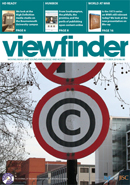
Copyright and You - article from Viewfinder magazine

(The following quotes are not from Viewfinder magazine)

"I think art is the only thing that's spiritual in the world. And I refuse to forced to believe in other people's interpretations of God. I don't think anybody should be. No one person can own the copyright to what God means." Marilyn Manson1


"I'm a bit cynical that it ever will be addressed properly. I think it is healthy to get some sort of copyright protection. But some of it has gone on forever." Peter Gabriel2


"Napster's only alleged liability is for contributory or vicarious infringement. So when Napster's users engage in noncommercial sharing of music, is that activity copyright infringement? No." David Boies3


"Only one thing is impossible for God: To find any sense in any copyright law on the planet." Mark Twain4

"Earlier generations of technology... have presented challenges to existing copyright law, but none have posed the same threat as the digital age." -John V. Pavlik, New Media Technology, 19965

Judging by the references to God in a couple of these quotes, it would seem that the issue of copyright is certainly capable of arousing strong feelings for some people. It has done so, and will probably continue to do so for years to come. Copyright is a controversial subject at the best of times, and it's a prickly one at that, to say the least. It can also be something of a legal minefield for anyone wanting to use original material created by someone else, be it an article from a book, a photo off a website, music, a video clip, or even someone's own video footage of, say a lecture for example.

In the latest (October) edition of Viewfinder (The Journal of the British Universities Film & Video Council), Jason Miles-Campbell, the Services Manager at JISC Legal, discusses Intellectual Property rights in education and how relevant the 1988 Copyright, Designs and patents Act is to staff and students.

Whatever your own stance is towards copyright law, anti, pro or just plain bewildered, it is good practice to be aware of where you stand with the regards the law relating to copyright if you are a member of staff or a student. Miles-Campbell obviously falls into the pro-copyright camp, and certainly doesn't advocate the flagrant disregard of copyright owners' rights, "even if anarchy seems like a good academic trait to some". Needless to say, he goes on to outline some "good reasons for the respect of creativity", among them the advocacy of "academia... leading by example".

If you'd like to know a bit more about your responsibilities with in relation to academic use of film and video, and copyright matters regarding clearance rights for recording lectures etc. you might want to read the whole article provided by kind permission of Sergio Angelini (Information and Publications Executive - BUFVC). 'Copyright and You' - http://insight.glos.ac.uk/departments/lis/media/Documents/bufvc-viewfinder-80-pp.14-15.pdf6

References

1- 4 Copyright Quotes, Brainy Quote, N/D
< http://www.brainyquote.com/quotes/keywords/copyright.html>[Accessed 29/10/2009]

5. 'Quotes on Copyright', Ball State: Education Redefined, 2008,
< http://vgncds.bsu.edu:82/library/article/0,,16120--,00.html>[Accessed 29/10/2010]

6. Jason Miles-Campbell, 'Exit Stage Rights', Viewfinder: The Journal of the British Universities Film & Video Council, (London: BUFVC, 2010), October, no.80, 2010, pp.14-15.